
Spring

Summer

Edible

Back To Foraging Guide
Rosebay Willowherb
Chamaenerion angustifolium
.jpg)


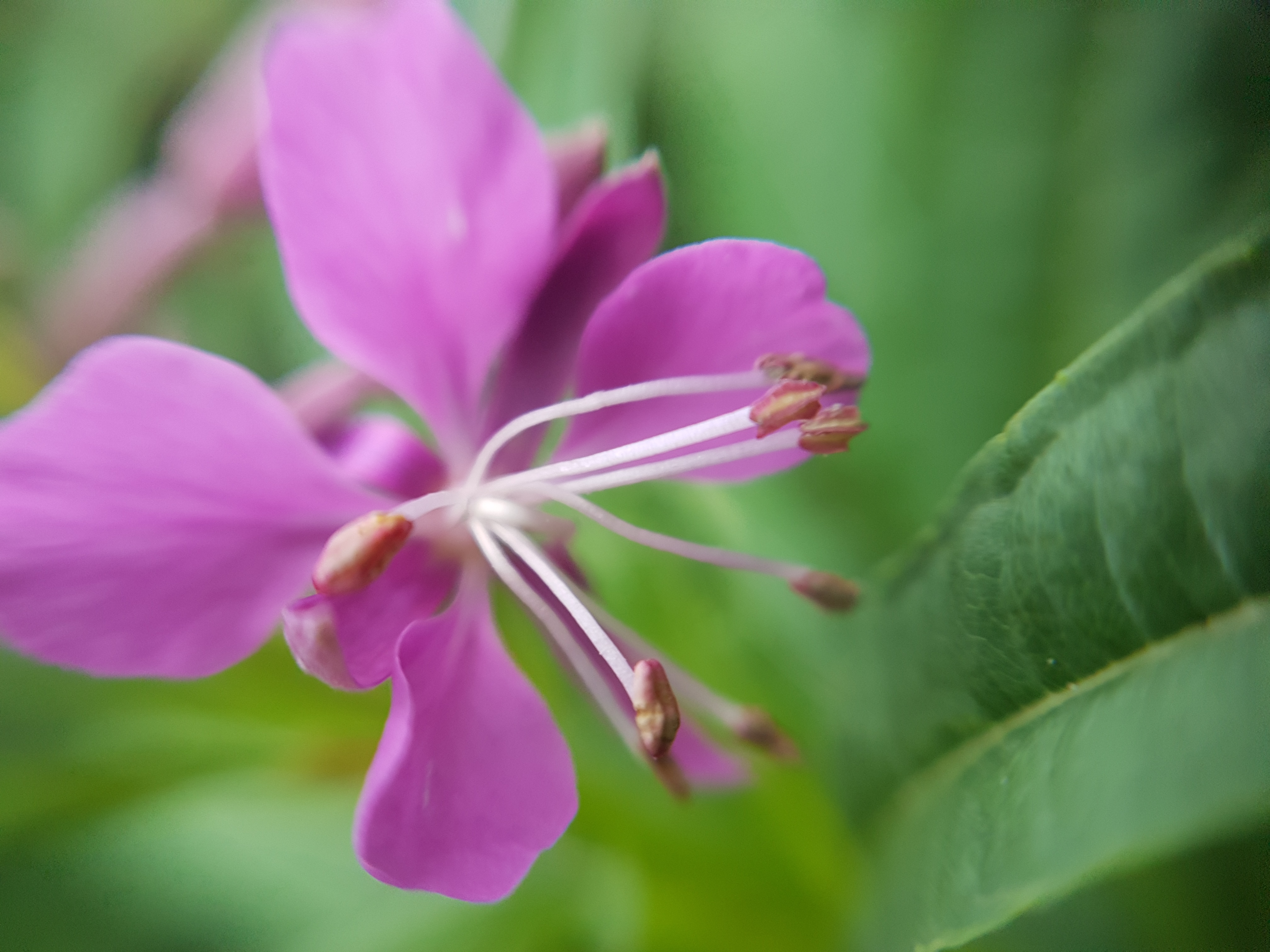


Chamaenerion angustifolium is a fast growing perennial growing to 2m by 1m. It is a pioneer species and is quick to take over forest clearings and burnt ground. It is tall and straight with narrow leaves and a bright pink raceme of flowers at the tip. After flowering, the tip is usually covered in a silky, white fluff which are the fine hairs attached to the seeds.
Bombweed, Epilobium angustifolium, Fireweed, St. Anthony's laurel

Cap
Gills
Stem
Flesh
Leaves
The leaves are long and thin (lanceolate) and arranged spirally on the stem. The leaves have a central vein, whilst the outer veins join together to form a margin around the edge of the leaf.
Flowers
The inflorescence is a symmetrical terminal raceme which flowers first at the bottom and last at the top. The flowers are 2 to 3cm in diameter, slightly asymmetrical, with four magenta to pink petals and four narrower pink sepals behind.
Seeds
The plant can have as many as 80,000 seeds, with up to 400 per upright, reddish-brown, linear seed capsule. The capsules open when ripe and each seed is carried away on the wind attached to silky hairs. The plant also spreads by its root systems.
Stem
The stems are upright, hairless and a reddish/purple colour (sometimes green when they’re young). They are hollow with an edible pith inside.
Fruit
Taste
The leaves make an excellent tea substitute, exactly like black tea.
Frequency & law
Regionally very common and not restricted.
The nuanced bit

Possible confusion
Superficially, other willowherbs look similar, but the leaf shape and inflorescence are a good indicator of species .

Habitat
Commonly found across Europe, temperate Asia and north America. It likes to grow on waste ground, rocky ground, woodland edges and gardens. It is a quick coloniser and will effectively spread and take over waste ground once it gets a foot hold.

How to harvest
The young shoots are usually starting to appear from March, and the flowers begin to open from late May.

Cooking tips
n/a

Other uses
A fibre obtained from the outer stems is used to make cordage. The ‘cottony’ seed hairs are used as an insulation or as a tinder. The powdered inner pith can be applied to the hands and face to give protection from the cold.

Folklore
It has found use in poetry and prose since at least the 19th century. Rudyard Kipling wrote, “The fire-weed glows in the centre of the drive ways”. In The Fellowship of the Ring, J. R. R. Tolkien lists fireweed as one of the flowering plants returning to the site of a bonfire inside the Old Forest.
A 3-hour session with a foraging expert, including ID work, finding and tasting wild ingredients, and a wild snack in Lymm
A 3-hour session with a foraging expert, including ID work, finding and tasting wild ingredients, and a wild snack at Bassenthwaite Lake Station


